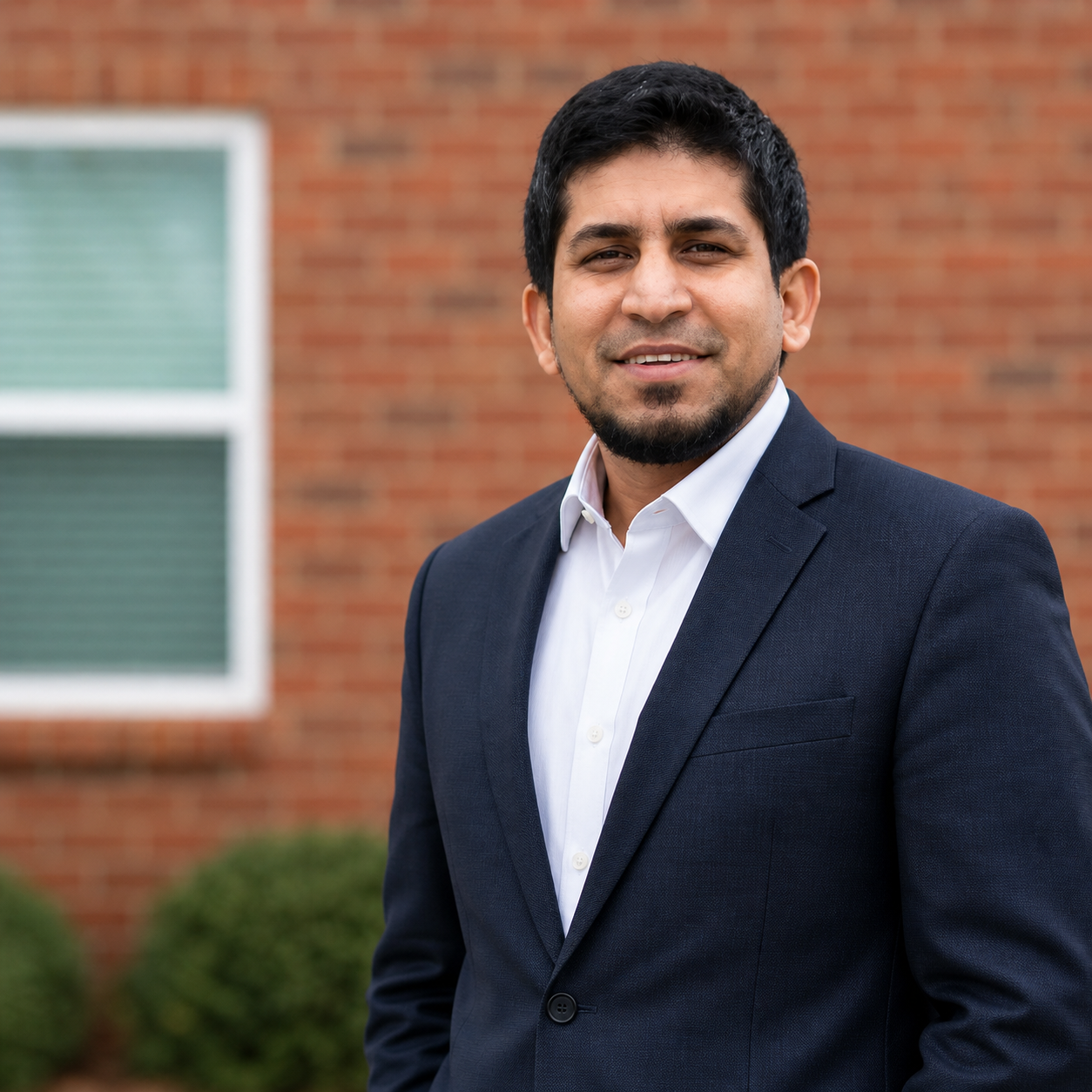
Dr. Mohammad Masum

Assistant Professor, Applied Data Science
San José State University

Building reliable, interpretable, and real-world AI systems using LLMs, multimodal learning, and edge intelligence.

Google Scholar | LinkedIn | Email Download CV

About

I am an Assistant Professor in Applied Data Science at San José State University. My research focuses on Large Language Models, multimodal AI, cybersecurity, healthcare AI, and edge intelligence systems.

Current Research Directions

My current research agenda focuses on next-generation AI systems that can reason, adapt, predict, and support human decision-making across complex real-world environments.

Agentic AI and Autonomous Reasoning Systems
Designing AI systems capable of planning, coordinating tools, evaluating evidence, and supporting complex decision-making workflows.
World Models and Predictive Intelligence
Developing AI systems that learn structured representations of environments, anticipate future states, and reason over possible outcomes.
Large Language Models and Generative AI
Advancing reliable, interpretable, and domain-aware LLM systems for cybersecurity, healthcare, information management, and real-world AI applications.
Human-Centered Multimodal AI
Building AI systems that integrate language, vision, and contextual understanding while remaining transparent, responsible, and aligned with human needs.

Recent News & Updates

2026

Received the CIDS RSCA Graduate Research Assistant Award for Fall 2026 to support Agentic World Models for Evidence-Grounded Early Warning of Enterprise Cyberattacks.

2026

Received a Writing Across the Curriculum (WAC) Faculty Workshop Award at San José State University to develop and deliver a faculty workshop on AI-supported writing pedagogy and explainable human–AI co-writing practices in writing-intensive courses.

2026

Received the CIDS CURF ASPIRE Grant at San José State University supporting student-led research on robust, device-agnostic wellness prediction using large language models.

2026

Awarded the IDS Summer Research Stipend, College of Information, Data and Society (CIDS), supporting research on interpretable multi-agent large language model systems for cybersecurity analytics and malware detection.

2026

Yilin Sun was selected among the Top 10 finalists in the SJSU Grad Slam competition for research on interpretable agentic AI frameworks for malware analysis.

2026

Completed the SJSU Research Impact Academy (RIA), a university-wide program focused on research communication, public impact, and strategic engagement.

2026

Five graduate students are completing MS thesis research this semester across cybersecurity AI, wearable intelligence, recommendation systems, clinical NLP, and LLM-based analytics.

2025

Tanya Yadav received the SJSU Research and Innovation Student RSCA Fellowship for research in AI-driven cybersecurity systems, resulting in two peer-reviewed publications.

2025

Two graduate students successfully completed MS thesis research under my supervision in multimodal AI and open-vocabulary vision systems.

2024

Received the SJSU RSCA Seed Grant supporting research in edge AI and physiological signal analysis for non-invasive health monitoring, leading to a peer-reviewed publication in MDPI Electronics (2025).

Research Areas

LLMs & RAG
Reliable and interpretable language models
Multimodal AI
Vision-language understanding
Cybersecurity AI
Malware, phishing, intrusion detection
Healthcare AI
Medical imaging & wearable systems
Edge AI
TinyML & efficient deployment

Featured Projects

Multimodal Recommendation Systems
Vision-language models, RAG, and attribute-aware AI for e-commerce intelligence.

Open-Vocabulary Product Understanding
Agentic AI, multimodal segmentation, and commercial content understanding.

Wearable AI and Multimodal Health Intelligence
LLM-driven wellness prediction using wearable sensors and physiological reasoning.

TinyPulse+
TinyML for blood pressure monitoring
Interpretable AI for Malware Analysis
LLM-native reasoning frameworks for explainable static malware detection.

RESEARCH & SCHOLARSHIP

Publications

Peer-reviewed research in generative AI, multimodal learning, cybersecurity, healthcare intelligence, and applied data science.

2026
JournalMachine Learning with Applications

WellFusion: Hybrid Numerical–Semantic Representations for Multi-Target Wellness Classification from Wearable Measurements

Yu, C.-H., & Masum, M.

IN BRIEF

WellFusion combines numerical wearable measurements with readable categories to predict four wellness outcomes, revealing important performance trade-offs rather than consistent gains over simpler approaches.

Read Publication ↗
JournalMachine Learning with Applications

Inklude: A Conditional Generative Model for Stylized Air-Drawing Augmentation

Singh, S., Kankanala, S. R., Chen, W., & Masum, M.

IN BRIEF

Inklude combines hand-motion recognition with conditional image generation to transform drawings made in the air into stylized images, exploring more accessible gesture-based creative tools.

Read Publication ↗
JournalKnowledge-Based Systems

PE2Prompt: A Large Language Model-Native Framework for Interpretable Static Malware Analysis

Sun, Y., & Masum, M.

IN BRIEF

PE2Prompt transforms numerical malware features into structured language prompts, enabling LLM-based classification with traceable feature descriptions without task-specific model retraining.

Read Publication ↗
JournalMachine Learning with Applications

Multimodal StyleFusion: Cross-Attention Learning for Fashion Style Recognition

Han, D., Huang, S.-Y., Liang, J., & Masum, M.

IN BRIEF

StyleFusion combines clothing images with LLM-generated descriptions using cross-attention, showing when textual cues help recognize abstract fashion styles and when fine-tuned vision models suffice.

Read Publication ↗
JournalBioengineering

HybridSense-LLM: A Structured Multimodal Framework for Large-Language-Model-Based Wellness Prediction from Wearable Sensors with Contextual Self-Reports

Yu, C.-H., & Masum, M.

IN BRIEF

HybridSense-LLM combines wearable signals, statistical features, and structured prompting to estimate stress, fatigue, readiness, and sleep quality, revealing which prompting strategies suit different outcomes.

Read Publication ↗
JournalElectronics

Explainable Multi-Agent LLM Framework for Phishing Email Detection via Role-Specialized Evidence Decomposition

Yadav, T., & Masum, M.

IN BRIEF

Three specialized LLM agents examine language, psychological manipulation, and sender identity to detect phishing emails while producing structured, auditable evidence for each decision.

Read Publication ↗
JournalElectronics

Clinically Aligned Long-Context Transformers for Cross-Platform Mental Health Risk Detection

Tekale, A., & Masum, M.

IN BRIEF

A clinically aligned Longformer analyzes extended social-media histories for mental-health risk, demonstrating cross-dataset transfer while highlighting why compatible labels matter for reliable evaluation.

Read Publication ↗
JournalAlgorithms

Understanding Tradeoffs in Clinical Text Extraction: Prompting, Retrieval-Augmented Generation, and Supervised Learning on Electronic Health Records

Yadav, T., Tekale, A., Chong, J., & Masum, M.

IN BRIEF

Comparing prompting, retrieval-based terminology normalization, and supervised learning reveals when each extracts clinical information effectively—and why exact text matching can misjudge correctness.

Read Publication ↗
JournalAlgorithms

Agentic Hallucination Risk Scoring for Medical LLMs via Uncertainty Quantification and Clinical Knowledge Injection

Kapadia, M., & Masum, M.

IN BRIEF

An agentic safety pipeline scores uncertainty in medical LLM answers and selectively adds clinical knowledge, offering configurable safeguards against potentially incorrect responses.

Read Publication ↗
JournalExpert Review of Respiratory Medicine

Racial/Ethnic Disparities in Environmental Respiratory Allergies Among Cancer Patients: National Health Interview Survey Analysis

Mamudu, L., et al. (including Masum, M.)

IN BRIEF

Analysis of a national U.S. survey identifies racial and ethnic differences in respiratory allergy diagnoses among cancer patients, informing more targeted health-equity research.

Read Publication ↗
ConferenceIEEE ICAIC

HRIT: A Human-Readable Framework for Phishing URL Detection Using Large Language Models

Yadav, T., & Masum, M.

IN BRIEF

HRIT converts numerical URL security features into meaningful language indicators, helping LLMs identify phishing links without fine-tuning and making their inputs easier to interpret.

Read Publication ↗
2025
JournalInternational Journal of Information Management Data Insights

A Multimodal Framework for Enhancing E-Commerce Information Management Using Vision Transformers and Large Language Models

Balachandran, A., & Masum, M.

IN BRIEF

BiLens fuses image features with LLM-generated captions to improve product search relevance, addressing limitations of image-only retrieval and keyword-stuffed descriptions.

Read Publication ↗
JournalElectronics

Enhancing Clinical Named Entity Recognition via Fine-Tuned BERT and Dictionary-Infused Retrieval-Augmented Generation

Sreenivas, S. C., Chowdhury, S., & Masum, M.

IN BRIEF

A two-stage system extracts medical terms using fine-tuned BERT and clarifies ambiguous terminology through dictionary-guided retrieval, improving the usefulness of clinical text extraction.

Read Publication ↗
JournalElectronics

LSE-Net: Integrated Segmentation and Ensemble Deep Learning for Enhanced Lung Disease Classification

Basavaraju, B. K., & Masum, M.

IN BRIEF

LSE-Net segments lung regions with U-Net++ and combines two classifiers to recognize diseases in chest X-rays, reducing irrelevant image information during prediction.

Read Publication ↗
JournalElectronics

Deep Learning for Non-Invasive Blood Pressure Monitoring: Model Performance and Quantization Trade-Offs

Devadasan, A. V., Sengupta, S., & Masum, M.

IN BRIEF

This study compares neural models for cuffless blood-pressure estimation and tests quantization, showing how compact models can balance prediction error, memory use, and inference speed.

Read Publication ↗
ConferenceIEEE Big Data

Do Multimodal Large Language Models Compete with Specialized Object Detection Models? A Quantitative Benchmark

Dunton, A., Govindarajulu, P., & Masum, M.

IN BRIEF

A controlled benchmark compares multimodal LLMs with dedicated object detectors, showing that fine-tuning improves general-purpose models but specialized detectors still lead in localization accuracy.

Read Publication ↗
ConferenceIEEE CAI

VisioRAG: A Multimodal Framework for Enhancing Recommendation System Using Vision Transformers and RAG

Balachandran, A., & Masum, M.

IN BRIEF

VisioRAG combines visual features, image captions, and retrieval-augmented language processing to produce more context-aware e-commerce product recommendations than image-only approaches.

Read Publication ↗
ConferenceIEEE CAI

InvadeAI: INteractive ADvertising with Multimodal AI

Dunton, A., Vyas, R., Shah, H., Sankathala, S., & Masum, M.

IN BRIEF

InvadeAI connects product detection in images with language-based product matching and an interactive interface, exploring contextual shopping links within visual media.

Read Publication ↗
ConferenceIEEE CAI

BARTNet: Context-Aware Deep Learning Framework for BART Ridership Forecasting

Suryadevara, L. S. R., et al. (including Masum, M.)

IN BRIEF

BARTNet combines transit history with contextual factors and deep learning to forecast ridership, outperforming a traditional ARIMA baseline in the reported experiments.

Read Publication ↗
2024
JournalInternational Journal of Information Management Data Insights

Genie: Enhancing Information Management in the Restaurant Industry Through AI-Powered Chatbot

Gupta, M., Dheekonda, V., & Masum, M.

IN BRIEF

Genie uses language embeddings and intent classification to answer restaurant customer questions and support orders and reservations, reducing routine service workload.

Read Publication ↗
JournalPLOS ONE

Comorbidities and Their Association with COVID-19 Mortality in Mexico Between January 2020 and August 2021

Lowhorn, R. J., et al. (including Masum, M.)

IN BRIEF

Analysis of 2.9 million Mexican COVID-19 cases identifies demographic and medical factors associated with mortality, supporting more informed risk assessment.

Read Publication ↗
ConferenceIEEE Big Data

TinyML for Cybersecurity: Deploying Optimized Deep Learning Models for On-Device Threat Detection on Resource-Constrained Devices

Arcot, S., Masum, M., et al.

IN BRIEF

Evaluates compressed deep learning models for on-device cyberattack detection, measuring how quantization changes accuracy, memory requirements, and inference speed on limited hardware.

Read Publication ↗
ConferenceIEEE COMPSAC

ActivePCA: A Novel Framework Integrating PCA and Active Machine Learning for Efficient Dimension Reduction

Bhyregowda, P., Masum, M., et al.

IN BRIEF

ActivePCA selects informative records before applying principal component analysis, reducing data and labeling demands while retaining useful predictive information in medical datasets.

Read Publication ↗
ConferenceIEEE COMPSAC

E-SMOTE: Entropy Based Minority Oversampling for Heart Failure and AIDS Clinical Trails Analysis

Veerla, S., Devadasan, A. V., Masum, M., et al.

IN BRIEF

E-SMOTE uses entropy to select informative minority-class samples for synthetic oversampling, addressing class imbalance with fewer examples in clinical datasets.

Read Publication ↗
ConferenceIEEE COMPSAC

Fine-Tuned Variational Quantum Classifiers for Cyber Attacks Detection Based on Parameterized Quantum Circuits and Optimizers

Rahman, M. A., Akter, M. S., et al. (including Masum, M.)

IN BRIEF

Tests quantum circuit designs and optimizers for cybersecurity anomaly classification, identifying configurations that improve performance on the NSL-KDD dataset.

Read Publication ↗
ConferenceIEEE CCWC

CMI: Cluster-Centric Missing Value Imputation with Feature Consistency

Gupta, M., Shah, S., Masum, M., & Kosaraju, S. C.

IN BRIEF

CMI fills missing numerical values using similarities within data clusters and explains feature importance with SHAP, improving interpretability in healthcare datasets.

Read Publication ↗

Explore the complete publication record and citation history.

Google Scholar ↗

Teaching

My teaching connects mathematical foundations, modern AI systems, and real-world applications. I design graduate-level courses that emphasize conceptual depth, hands-on implementation, reproducible experimentation, and responsible use of AI.

DATA 220: Mathematical Methods for Data Analytics
Linear algebra, optimization, probability, statistics, and mathematical reasoning for data science.
DATA 245: Machine Learning Technologies
Supervised and unsupervised learning, feature engineering, dimensionality reduction, model evaluation, explainability, and applied machine learning systems.
DATA 255: Deep Learning Technologies
Neural networks, CNNs, RNNs, transformers, generative models, and applied deep learning projects.
DATA 266: Generative AI and Language Models
LLMs, prompt engineering, RAG, fine-tuning, RLHF, multimodal AI, and responsible deployment.

Teaching Approach

Selected Teaching Materials

Selected public teaching resources, sample assignments, and project guidelines will be shared here. Full lecture materials are provided only to enrolled students through the course learning platform.

RESEARCH GROUP · SAN JOSÉ STATE UNIVERSITY

ART Lab

Agentic Reasoning & Trust

Advancing intelligent systems that reason, adapt, and earn trust.

01 / OUR MISSION

Making Autonomous Reasoning Verifiable.

We investigate how AI systems can reason, plan, and make decisions grounded in evidence rather than plausible outputs. Through multi-agent architectures, structured reasoning, and systematic evaluation, we develop methods to make autonomous AI more reliable, interpretable, and accountable.

02 / OUR VISION

From Generating Answers to Understanding the World.

We envision AI systems that can model complex environments, anticipate consequences, and adapt their decisions as new evidence emerges. Our long-term goal is to advance autonomous intelligence that combines predictive reasoning with verifiable decisions, transparent behavior, and meaningful human oversight.

Research Team

Our graduate researchers investigate emerging AI methods through rigorous experimentation, collaborative research, and scholarly publication.

RD

Rahul Mohan Devi

Trustworthy LLMs & Evidence Verification

RAG • Evidence Completeness • Reliable AI Reasoning
MJ

Mamta Jha

Conversational AI & Intent Understanding

Dialogue Context • Intent Classification • Semantic Expansion
RB

Rishi Boppana

Multi-Agent AI Reliability & Failure Attribution

Agent Debugging • Error Localization • LLM-Based Failure Analysis
MG

Mahak Gupta

Agentic AI Security & Trust

Agent Memory Poisoning • Adversarial AI • Multi-Agent Security
YS

Yilin Sun

Interpretable Cybersecurity AI

PE2Prompt • Agentic Malware Analysis • LLM Reasoning
TY

Tanya Yadav

AI for Cybersecurity

Phishing URLs • Spam Detection • Agentic AI • LLM Security
AD

Andrew Dunton

Open-Vocabulary Vision Systems

Image Segmentation • Agentic AI • Vision-Language Models
SH

Shao-Yu Huang

Fashion Intelligence Systems

Style Classification • Recommendation Systems • Multimodal AI
AT

Aditya Tekale

Clinical AI and Mental Health

Longformer Transformers • Clinical NLP • LLM-based Classification
CY

Cheng-Huan Yu

Wearable AI and Wellness Prediction

HybridSense-LLM • Physiological Reasoning • Health AI
YK

Yashasvi Kanchugantla

Reliable Tabular AI Systems

Complexity-Aware Retrieval • In-Context Learning • LLM Analytics

Contact

Email: mohammad.masum@sjsu.edu
Google Scholar: View Profile
LinkedIn: Profile